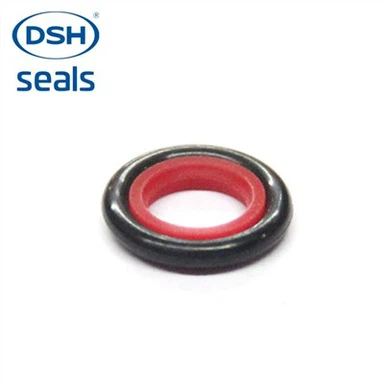
Use of O-ring seals
Dec 22, 2022
I. Use of O-ring
Seals in a variety of hydraulic, pneumatic parts pipe joints, cylindrical surface and flange surface and other combinations are widely used. For the O-ring used in the process of movement, when the pressure in the work is greater than 10MPa, such as one-way pressure, set a retaining ring on the other side of the O-ring pressure direction; such as two-way pressure, then put a retaining ring on each side of the O-ring. In order to reduce friction, you can also use wedge-shaped retaining ring. When the pressure fluid is applied from the left, the right retaining ring is pushed up and the left retaining ring is not in contact with the sealed surface, so the friction force is reduced. In general, the use of retaining rings increases the friction of the sealing device, and wedge-shaped retaining rings are of great importance in reducing this friction. For fixed O-rings, retaining rings are also required when the working pressure is greater than 32 MPa. The working pressure of O-ring can be greatly increased after using retaining ring. The static sealing pressure can be increased to 200~700MPa; the dynamic sealing pressure can also be increased to 40MPa, and the retaining ring also helps the O-ring to maintain good lubrication. In the use of O-ring as a reciprocating motion seal, must pay attention to the seal full tone rolling twist caused by the breakage and increased friction caused by adhesion, and failure. o-ring if properly assembled, and the use of appropriate conditions, generally less likely to produce rolling or twisting in the reciprocating motion state, because the contact area of the O-ring and seal groove is greater than the frictional contact area on the sliding surface. And the O-ring itself resistance to the original can prevent twisting. At the same time, the distribution of friction also tends to keep the O-ring in its groove stationary, because static friction is greater than sliding friction, and sealing groove surface is generally not as smooth as the sliding surface.
O-rings are generally used in low-pressure pneumatic systems below 0.7 MPa and have high requirements for tightness. In the pneumatic system, attention must be paid to the lubrication of O-rings.
Usually, the sliding surface is plated in order to improve corrosion resistance and wear resistance. The material of the plating also has a certain influence on the applicable life of the O-ring, generally good chrome-plated steel. the service life of the O-ring is directly related to the use conditions, assembly quality, the material of the moving parts, processing accuracy, lubrication conditions, dust control measures and many other factors. Therefore, the exact service life of the O-ring, according to the specific working conditions to make a judgment. O-rings for dynamic seals are perishable parts, and in any reciprocating motion seal application, they should be used according to the rated data or capacity of the seal and be properly assembled so that satisfactory performance can be obtained.
Sealing with O-rings should be done so that the direction of pressure and the direction of friction are as opposite as possible; if the two forces act in the same direction, the tendency for the O-ring to extrude is much more pronounced and may reduce the effective pressure rating. If the groove design cannot be set so that the direction of pressure is opposite to the direction of friction, it is appropriate to use a retaining ring at a pressure of 7~10MPa. Self-priming hydraulic pump or instantaneous flow rate greater than 10m / s pipeline, can produce negative pressure (vacuum) phenomenon, when the working state of the seal for negative pressure. The negative pressure is different from the positive pressure seal. And contrary to the positive pressure oil leakage phenomenon, the negative pressure is suction. Therefore their sealing conditions are also opposite. If you don't pay attention to it, and mistakenly use the positive pressure for the negative pressure, the O-ring may be sucked in, causing air to enter the hydraulic system and causing the tank to "open". For the seal that may generate negative pressure or vacuum, protective grooves should be used to prevent the O-ring from being sucked into the orifice.
Second, the installation of O-ring
O-ring installation quality has an important impact on its sealability and service life. Leakage problems are often caused by poor installation. The installation process does not allow the O-ring is scratched and positioned incorrectly installed, as well as O-ring is distorted. Before assembly, the sealing groove, sealing coupling surface must be strictly cleaned; at the same time the O-ring assembly to be passed in the surface grease. In order to prevent the O-ring from being cut or scratched by sharp edges such as sharp corners and threads during installation, the introduction angle of 15°~30° should be left at the shaft end and hole end of the installation. When the O-ring needs to pass through the external thread, a special thin-walled metal guide sleeve should be used to cover the external thread. In addition, it is necessary to prevent missing installation or using scrap O-rings. And also pay attention to the installation direction of the retaining ring.
Third, the O-ring storage
O-ring is a perishable part, so it needs to be properly stored. o-ring storage properly or not, has a great impact on its service life. o-ring storage should do: 1) avoid placing in direct sunlight, moisture and air circulation. Because these are factors that accelerate the aging of the O-ring material. The appropriate temperature for storing O-rings is 0 ~ 20 ℃, the appropriate air humidity is more than 70%. (2) O-ring storage must leave the heating equipment 1m away, and not allowed to be placed in the room with acid, alkali. 3) O-ring in storage, do not allow pressure, so as not to cause permanent deformation of compression. (4) storage O-ring seals of polyethylene plastic bags, must be recorded in its manufacturing and factory date, so that the order of use. O-ring seal is a typical extruded seal. the compression rate and stretching of the O-ring cross-sectional diameter is the main content of the seal design, which is important for sealing performance and service life. the O-ring is generally installed in the sealing groove to play a sealing role. the good sealing effect of the O-ring depends largely on the O-ring size and groove size Correct matching, the formation of a reasonable amount of seal compression and tension. Seal device design and processing, if the O-ring compression is too small, it will cause leakage; compression is too large will lead to O-ring rubber stress relaxation and cause leakage. Similarly, the O-ring work in stretching too much, will also accelerate aging and cause leakage. The standards of various countries have more stringent provisions.