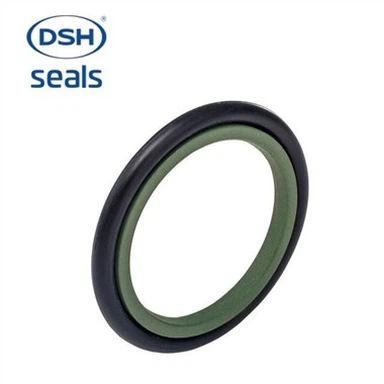
Basic requirements for seals
Nov 17, 2022
Basic requirements for materials: pressure resistance; abrasion resistance; temperature resistance; high elasticity; self-sealing, follow-through; low friction; media resistance.
Pressure resistance
The seal mainly relies on closing the gap between the bonding surfaces to achieve the sealing effect, and inevitably suffers from the sealing pressure to the gap extrusion, and its ability to resist extrusion depends on the strength of the material itself. There are four ways to solve the problem: 1) reduce the sealing gap; 2) improve the material strength, such as polyurethane to nitrile rubber; 3) add a retaining ring; 4) use a reasonable geometry.
Abrasion resistance
Seals are sealed by close cooperation with the sealing surface, using the sealing lip of the plowing action to wipe down the oil film and achieve sealing, improve the wear resistance of seals are as follows: 1) improve the material strength; 2) design a suitable lip form, control the lip contact width; 3) improve the processing quality of the sealing surface: a reasonable range of roughness roughness greater than Ra1.6μm, the coefficient of friction is large, roughness less than Ra0.1μm, it is difficult to maintain the lubricant film, the friction coefficient increases instead; 4) reasonable processing methods.
The basic methods to solve the leakage of mechanical products are the following five: 1) reduce the pressure difference between inside and outside the sealing part; 2) maintain a lubricating film on the sealing mating surface; 3) eliminate the fluid flow causes leakage; 4) increase the fluid flow resistance at the leakage part; 5) direct the leaking fluid to a harmless direction or make it flow back to the reservoir. Through the above analysis, the basic requirements for the seals are as follows: 1) good sealing performance and media resistance within a certain range of flow rate, pressure and temperature; 2) for dynamic seals, the friction resistance and friction coefficient are required to be small and stable; long working life, less wear during the working process; after wear, the amount of wear can be compensated automatically to a certain extent.