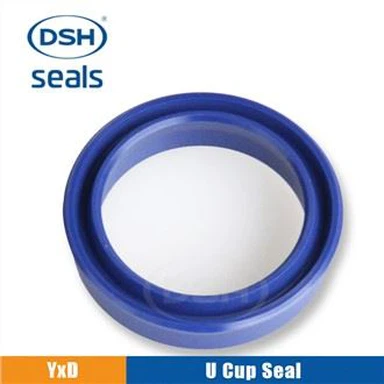
Materials Used for Standard Hydraulic and Pneumatic Seals
Jun 18, 2022
Hydraulic and pneumatic seals are the basic parts of the industry and the basic parts of industrial automation. They have been widely used in various industries such as industry, agriculture, aerospace, shipbuilding, metallurgy, mining, etc., and play a role in providing power sources to the system. An indispensable core element of the system.
The performance of hydraulic and pneumatic components directly reflects the level of industry and automation. Hydraulic and pneumatic components are wearing parts, and their service life directly affects the advancement, stability and long-term nature of automation and industrial machinery. These are directly related to its machining accuracy, structural rationality, material properties, and machining methods.
Sealing principle: Hydraulic pneumatic seals are divided into extrusion seals and lip seals according to their working principles. The extrusion seal relies on the compressive deformation filled in the groove to block the leakage channel and obtain the sealing effect. The home-shaped seal also relies on the pre-compression elastic deformation of the filling ditch to block the leakage channel, and under the action of the medium pressure, the lip further closes to the counterpart to enhance the blocking and sealing effect.
Material requirements for hydropneumatic seals:
Due to the difference in the performance of the sealing material itself, the sealing performance of the manufactured seals is also very different. Therefore, understanding the performance of the sealing material is a prerequisite for the correct design and selection of the seal. When selecting sealing materials, the following factors must be considered:
1. Media resistance
The degree of swelling of the material in the medium is directly related to the quality of the sealing performance, so when selecting the material for the hydraulic pneumatic seal, it is first necessary to consider whether it is compatible with the sealing medium.
2. Tensile strength
The tensile strength of the sealing material generally decreases with the increase of temperature, so its maximum operating temperature and mechanical strength at high temperature must be considered. Low tensile strength, prone to stress relaxation and permanent deformation, resulting in seal failure.
3. Wear resistance
The wear resistance of the material is an important performance of the dynamic seal, and the wear resistance is good, and the service life is long. The wear resistance of the material is closely related to the hardness of the material. The higher the hardness of the material, the more wear-resistant it is.
4. Permanent deformation
The hydropneumatic seal obtains the sealing ability by generating recoverable compression deformation in the sealing groove. Therefore, the permanent deformation of the sealing material should be small, the elasticity should be high, and the resilience should be strong. In addition, the permanent deformation of the material is related to temperature, low temperature and high temperature will increase the permanent deformation.
5. Elasticity
Extrusion type seals obtain sealing ability by relying on the resilience generated by the sealing material itself after being pressed, while lip seals may have eccentricity, and may rely on the elasticity of the material to compensate for the lack of contact stress of the seal. Therefore, elasticity is important for seals. The sealing effect is very important.
6. Hardness
Hardness is an important indicator of the sealing material, which depends on the roughness of the sealing surface. The rough sealing surface and the hardness of the seal should be lower, so that the sealing effect is good. In areas with high sealing pressure, the hardness of the seal should be increased to prevent excessive deformation of the seal or even extrusion. In addition, the hardness of the material has the characteristics of decreasing with the increase of the use temperature, and the hardness is high, and the wear resistance of the material is also strong.
7. Temperature resistance
The working temperature of the seal depends on the temperature of the sealing medium and the temperature rise of the seal itself during the movement. The temperature directly affects the sealing performance. If the temperature is too high, the aging of the sealing material will be accelerated, resulting in a significant decrease in the elasticity, hardness and other properties of the material, resulting in hardening. If the temperature is too low, the material will harden, lose its elasticity and reduce the sealing performance. Choose a material with a wider operating temperature range.
8. Permeability
Permeability also has an important impact on fluid sealing, and more attention should be paid to gas sealing, especially vacuum sealing. The permeability of various rubbers varies greatly.
Influence of friction on sealing: Friction is inevitable in dynamic sealing, and the magnitude of friction is related to factors such as seal material, fluid type, fluid pressure, working temperature, speed, and surface roughness of the sealing surface. It directly affects the sealing performance and life of the seal, as follows:
1) Friction causes seal failure and reduces service life;
2) Friction reduces the output pressure;
3) Frictional heat accelerates aging of seals and reduces service life;
4) At low speed, it is easy to cause the hydraulic cylinder to crawl.