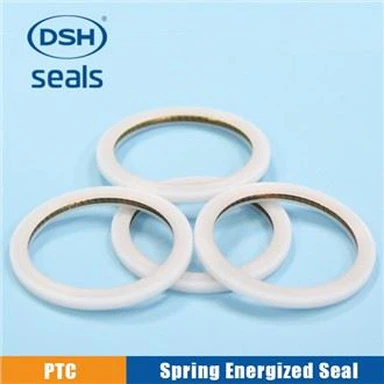
Material selection of spring energized seals in different working conditions
Nov 16, 2021
1. Virgin PTFE
Good chemical inertness, wide temperature resistance range, low friction coefficient, low starting friction, easy to wear and creeping phenomenon, in line with FDA certification, used in light load, chemical, food, and pharmaceutical industries. Operating temperature (-164℃ to +260℃).
2. Polytrichloroethylene PCTFE
Mechanical performance is better than PTFE, good low temperature characteristics, mainly used for corrosion resistance, low temperature occasions. Limited wear and heat resistance. Operating temperature (-196°C to +120°C).
3. PTFE filled glass fiber and molybdenum disulfide
Good physical properties, good wear resistance and creep resistance. It is a commonly used material. It has hardness requirements on the working surface (above HRC55). It is mainly used for high-speed, short-stroke, high-pressure reciprocating motion, and medium load. Operating temperature (-70℃ to +260℃).
4. PTFE filled Bronze
Good sliding and abrasion resistance, good creep resistance, good compression resistance, and good extrusion resistance. It is often used as materials such as step seals and guide wear rings. Water resistance and water-soluble solution are worse than other materials. Operating temperature (-70℃ to +260℃).
5. PTFE filled carbon fiber
Standard sealing material for hydraulic systems of mobile machinery and rotary motion occasions, especially suitable for water and water-soluble solutions. It has excellent wear resistance under high temperature, high pressure and high speed. Good application in dry or low lubrication conditions, it has an abrasive effect on soft metals. Operating temperature (-70℃ to +260℃).
6. PTFE filled carbon fiber and graphite
Good wear resistance and self-lubricating performance, used for heavy-duty materials without lubrication. Operating temperature (-70℃ to +260℃).
7. PTFE filled polyphenylester
It has good physical properties and has no hardness requirements on the working surface. It is widely used in soft metal materials such as stainless steel, aluminum, and bronze on the working surface. Operating temperature (-70℃ to +260℃).
8. Polyetheretherketone PEEK
Radiation resistance, hydrolysis resistance, compression resistance, corrosion resistance, and particularly abrasion resistance. Good friction performance, high modulus material. Operating temperature (-70℃ to +280℃).
9. Ultra-high molecular weight polyethylene UHMW-PE
It has good physical properties and is particularly wear-resistant. It is suitable for water-based media containing silt and particles. It has very good low-temperature performance and can be used in ultra-low temperature environments such as liquid nitrogen and liquid oxygen. Low requirements for working surface hardness. The working surface is chrome-plated steel, stainless steel, aluminum, bronze, etc. It conforms to FDA certification and can be used in the food and pharmaceutical industries. Operating temperature (-196℃ to +90℃).
10. Nitrile rubber NBR
It is suitable for use in petroleum-based hydraulic oil, glycol-based hydraulic oil, diester-based lubricating oil, gasoline, water, silicone grease, silicone oil and other media. It is currently the most versatile and lowest cost rubber seal. Not suitable for polar solvents, such as ketones, ozone, nitro hydrocarbons, MEK and chloroform. The general operating temperature range is -40°C to +120°C.
11. Polyurethane PU
Polyurethane rubber has very good mechanical properties, and its wear resistance and high pressure resistance are far superior to other rubbers. The aging resistance, ozone resistance and oil resistance are also quite good, but it is easy to be hydrolyzed at high temperature. Generally used for high pressure and wear resistant sealing links. The general operating temperature range is -45°C to +90°C.
12. Viton FPM
With a high degree of chemical stability, it is the best medium resistance among all elastomers. It has excellent weathering resistance, ozone resistance, and excellent physical and mechanical properties. The fluororubber has a relatively large solubility to gas, but the diffusion rate is relatively small, so the overall performance of the air permeability is also small. Because fluororubber has the characteristics of high temperature resistance, oil resistance, high vacuum resistance, acid and alkali resistance, and a variety of chemicals, it has been used in modern aviation, missiles, rockets, astronautics, naval vessels, atomic energy and other cutting-edge technologies, as well as automobiles, shipbuilding, and chemistry. , Petroleum, telecommunications, instruments, machinery and other industrial fields. The general operating temperature range is -45°C to +240°C.